

If you suspect a water leak in your home, one of the first questions that comes to mind is: how accurate is leak detection?
It’s a fair question. After all, if you’re going to rely on a service to locate a hidden problem—especially one behind walls or under concrete—you want to know that it will be precise. The good news is that modern methods are highly reliable. That’s why many property owners turn to water leak detection specialists to pinpoint leaks quickly and accurately without unnecessary damage.
Understanding what affects accuracy—and what to expect—can help you make informed decisions.
How Accurate Is Modern Leak Detection?
In most cases, professional leak detection is extremely accurate.
With the use of advanced tools and techniques, professionals can often locate leaks within a very small area—sometimes down to a few centimetres.
However, accuracy depends on several factors, including:
- The type of leak
- The location of the leak
- The materials surrounding the pipe
- The detection method used
While no method is perfect in every scenario, modern leak detection is far more precise than traditional trial-and-error approaches.
What Affects Leak Detection Accuracy?
Leak detection accuracy isn’t determined by a single factor. Instead, it’s influenced by a combination of conditions.
Type of Leak
Different leaks behave in different ways.
For example:
- Pressurised water leaks are easier to detect
- Slow or intermittent leaks can be harder to identify
- Non-pressurised leaks may require specialised techniques
The nature of the leak plays a significant role in how easily it can be located.
Location of the Leak
Leaks in accessible areas are generally easier to detect than those hidden in complex environments.
More challenging locations include:
- Beneath concrete slabs
- Underground pipes
- Behind thick walls
- Inside ceilings
In these cases, specialised equipment is essential.
To understand how professionals handle these situations, check out how plumbers find leaks underground.
Surrounding Materials
The materials around the pipe can affect how detection tools perform.
For example:
- Concrete can dampen sound signals
- Soil conditions can affect gas detection
- Insulation can mask temperature changes
Experienced technicians account for these factors when selecting the appropriate detection method.
How Detection Methods Impact Accuracy
Different technologies offer different levels of precision depending on the situation.
Acoustic Leak Detection
Acoustic detection is highly effective for pressurised systems.
By listening for the sound of escaping water, technicians can often pinpoint the location of a leak with impressive accuracy.
Learn more here about acoustic leak detection.
Tracer Gas Detection
Tracer gas is used when leaks are difficult to detect using sound alone.
It provides a highly accurate way to locate leaks, particularly in underground or non-pressurised systems.
See how tracer gas leak detection works in practice.
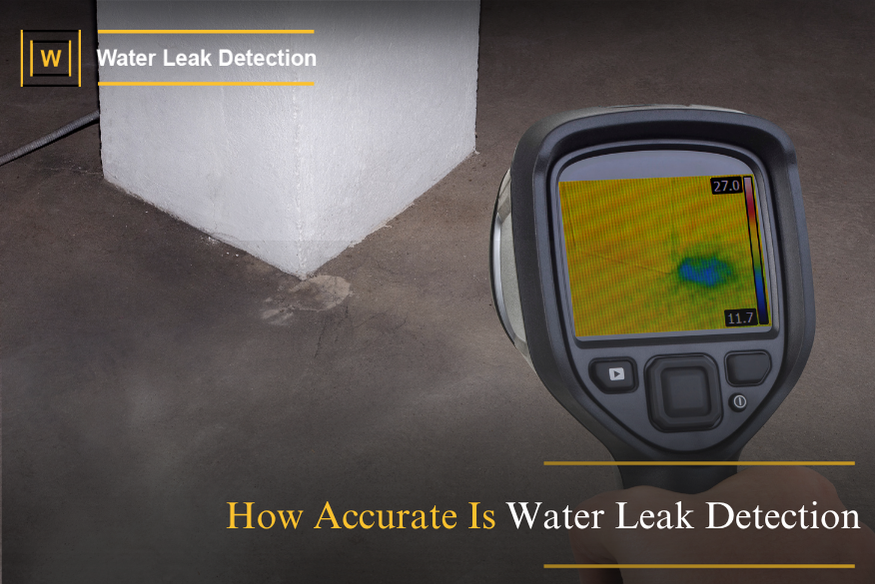
Thermal Imaging
Thermal imaging is useful for identifying temperature changes caused by moisture.
While it may not always pinpoint the exact leak location, it helps narrow down the affected area.
Combined Methods
In many cases, professionals use a combination of techniques to achieve the highest level of accuracy.
This layered approach improves reliability and ensures that leaks are located as precisely as possible.
Why Professional Experience Matters
Even with advanced tools, accuracy depends heavily on the skill and experience of the technician.
Experienced professionals know how to:
- Interpret data from different tools
- Adjust techniques based on conditions
- Identify false positives
- Confirm findings before recommending repairs
This expertise is what turns good equipment into accurate results.
How Accurate Is DIY Leak Detection?
DIY methods can be useful for identifying the presence of a leak, but they are limited when it comes to accuracy.
Basic checks can help you:
- Confirm water loss
- Identify visible signs of damage
- Detect unusual usage patterns
For example, you can check for leaks using your water meter. Learn how here: how to read your water meter for leaks.
However, DIY methods rarely provide the precision needed to locate the exact source of a leak.
What Level of Accuracy Should You Expect?
In most residential situations, professional leak detection can:
- Identify the general area of the leak with high confidence
- Pinpoint the exact location in many cases
- Provide enough precision for targeted repairs
This means:
- Less unnecessary damage
- Faster repair times
- Lower overall costs
While no system guarantees 100% precision in every scenario, modern detection methods are highly reliable.
The Cost of Inaccurate Leak Detection
Inaccurate detection can lead to:
- Unnecessary demolition
- Missed leaks
- Repeat repairs
- Increased costs
This is why relying on professional services is often the most cost-effective option.
A professional leak detection service ensures the problem is identified correctly the first time.
When Accuracy Matters Most
Accuracy is especially important in situations where:
- The leak is hidden
- The affected area is large
- Structural damage is a concern
- Repairs are complex or costly
In these cases, precise detection can make a significant difference in both time and cost.
Final Thoughts
Water leak detection has become highly accurate thanks to advances in technology and professional expertise.
While no method is perfect in every situation, modern techniques allow leaks to be located with a high degree of precision—often without causing unnecessary damage.
Understanding what affects accuracy helps you set realistic expectations and choose the right approach for your situation.
If you suspect a hidden leak and want accurate results without unnecessary disruption, getting expert help is the best way forward. Accurate detection today can save time, money, and stress tomorrow.
Please call us at Water Leak Detection today for a free consultation on 1300 425 325 or leave an inquiry.
